




NEWS

Adapting to the Digital Era and Sustainability

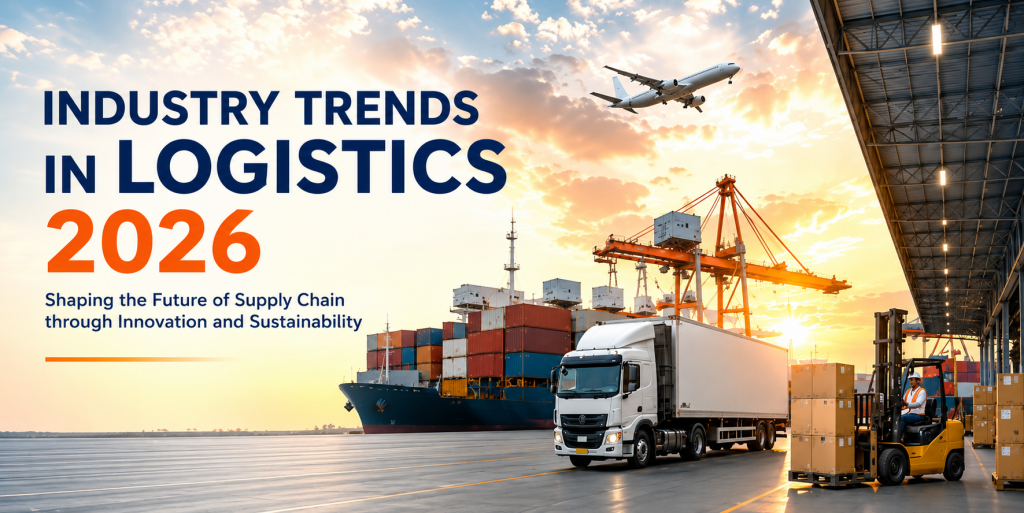
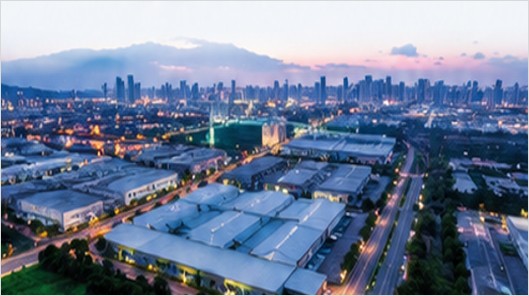
The logistics industry continues to be a key driver of the global economy. In 2026, logistics businesses are facing both new challenges and opportunities arising from technological advancements, changing consumer behavior, and increasingly stringent environmental regulations.

4. Key Trends Shaping the Future of Logistics


1. Digitalization and Intelligent Systems Enhance Efficiency Across Every Process


Digital technologies such as WMS, TMS, AI, and Big Data help optimize logistics operations by improving route planning, demand forecasting, and warehouse management. These solutions reduce costs, increase efficiency, and enhance service quality.


2. E-commerce Growth Drives Logistics Demand

The continued growth of e-commerce is increasing demand for warehousing and transportation services, especially last-mile delivery. Logistics providers must adapt by offering faster, more flexible, and customer-focused delivery solutions.


3. Sustainable Business Operations

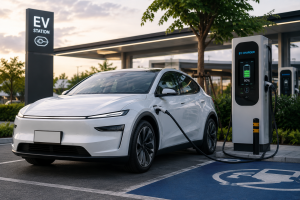
Businesses are placing greater emphasis on sustainability by adopting electric vehicles (EVs), optimizing transportation routes to reduce fuel consumption, and developing environmentally friendly warehouses. These initiatives help minimize environmental impact while supporting long-term business growth.


4. Continued Growth Opportunities for Thailand’s Logistics Industry

Thailand’s logistics industry continues to show strong growth potential, particularly in key economic and industrial zones that serve as strategic hubs for domestic and international distribution.


    Conclusion

   To remain competitive and achieve sustainable long-term growth, logistics providers must accelerate their transformation by         embracing digital technologies, optimizing costs, and adopting sustainable business practices.

5 May 2026

March 2026: A Double-Edged Sword—Opportunities and Challenges

The conflict in the Middle East, particularly the disruption of shipping routes through the Strait of Hormuz and the Red Sea,
has significantly impacted the global automotive industry, affecting costs, supply chains, and consumer behavior.

Negative Impacts: Rising Challenges

Logistics and Supply Chain Disruptions

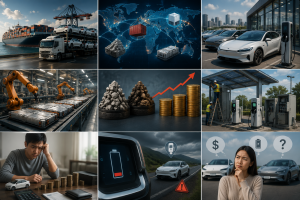
The disruption of shipping routes through the Strait of Hormuz and the Red Sea has delayed the transportation of fuel and raw materials, affecting Just-in-Time (JIT) manufacturing and increasing the risk of production disruptions.

Rising Transportation Costs

Vessels are required to reroute via the Cape of Good Hope, adding more than 4,000 miles and extending transit times by 10–14 days. As a result, freight rates and marine insurance costs have increased significantly.

Energy Price Volatility and Higher Production Costs

  • Crude oil prices (Brent) rose above USD 100–110 per barrel (March 2026)
  • The costs of key raw materials, including aluminum, steel, and petrochemicals, were estimated to increase by 15–25%.

Impact on EVs and Advanced Technologies

  • A shortage of helium has affected semiconductor manufacturing
  • battery supply chains have experienced delays and higher costs, impacting EV production.

Automakers’ Response Strategies

  • Adjust vehicle prices to reflect rising costs.
  • Accelerate nearshoring initiatives by relocating production closer to key markets.
  • Reduce dependence on long-distance transportation routes to strengthen supply chain resilience.


Positive Impact: Higher Fuel Prices Drive Interest in EVs

Rising Fuel Prices
Following the attacks in Iran and the disruption of shipping through the Strait of Hormuz, Brent crude oil prices increased to USD 90–100 per barrel, leading to higher fuel prices at gas stations worldwide.
Cost-Saving Motivation
As fuel costs rise, consumers are seeking more stable and cost-effective alternatives. With electricity prices generally experiencing less volatility than oil prices, interest in electric vehicles (EVs) and hybrid vehicles has increased significantly, reflected in higher online searches and stronger purchase consideration during March 2026.
Negative Impact (Continued): Challenges to Growth

Supply Chain Disruptions
Disruptions to shipping routes in the Red Sea and the Middle East have affected the transportation of automotive parts and batteries, increasing logistics costs and raising the risk of vehicle shortages and delivery delays.
Higher Production Costs
Battery manufacturing is highly energy-intensive. Rising global energy prices have increased production costs and may drive up the prices of critical minerals such as lithium and nickel.
Consumer Confidence
Political uncertainty and inflationary pressures have led some consumers to postpone purchasing new vehicles, slowing market demand.
Despite the challenges facing transportation and supply chains, experts view this as a critical turning point that reinforces the importance of adopting clean energy to achieve greater energy independence, particularly in countries that rely heavily on imported oil.

“Conflict is accelerating consumer interest in electric vehicles (EVs) as people seek to reduce their dependence on rising fuel prices. However, in practice, buyers may face higher vehicle prices due to increased production costs and longer delivery times caused by disruptions in the global logistics network.           

Source: Thairath Online
14 May 2026.

Land Bridge Project
Connecting the Gulf of Thailand and the Andaman Sea
Transforming Regional Transportation and Logistics

The Land Bridge Project is expected to create significant employment and economic opportunities through continuous business development. It will promote commercial and urban development, green industries, tax-free investment zones, and high-value sectors such as EVs, AI, halal products, food processing, and other environmentally friendly industries, strengthening Southern Thailand as a global logistics and business hub.

How Will the Land Bridge Project Drive Economic Growth and Benefit the Public?

The Ministry of Transport, through the Office of Transport and Traffic Policy and Planning (OTP), is advancing the Southern Economic Corridor (SEC) Land Bridge Project to connect the Indian and Pacific Oceans by leveraging Thailand’s strategic geographic location.

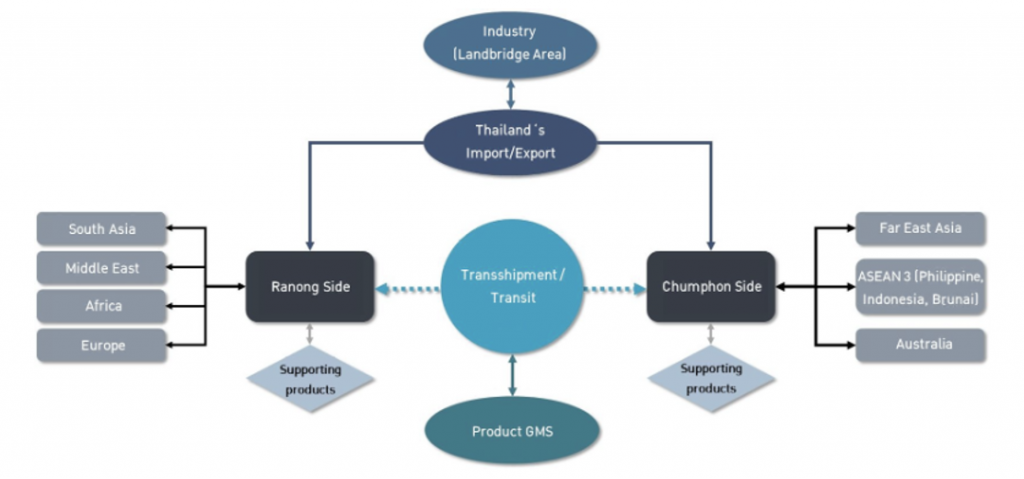
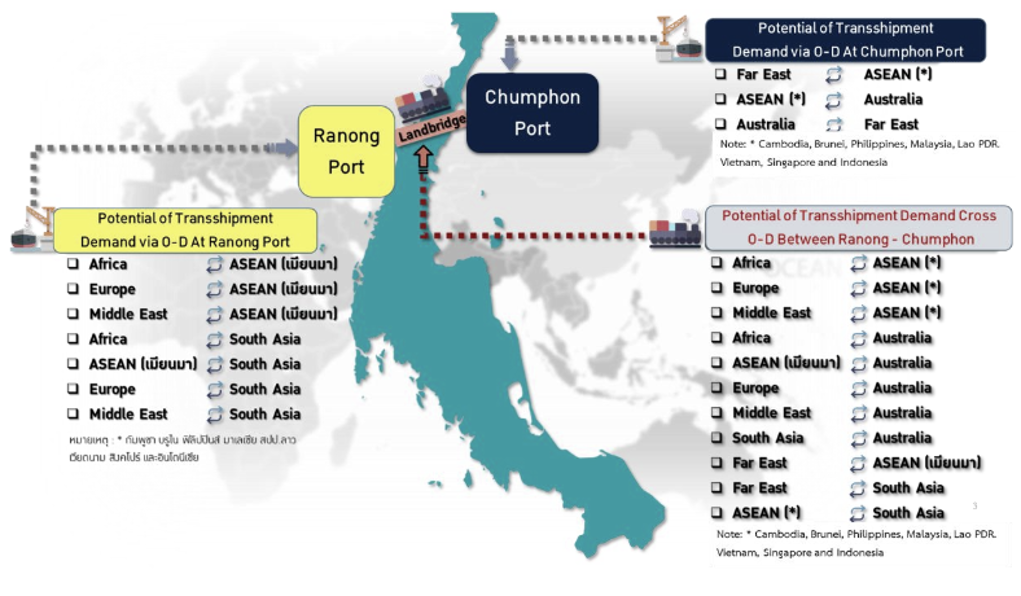
The project includes the development of deep-sea ports in Ranong and Chumphon, linked by road and rail under the “One Port, Two Sides” concept. It aims to establish Smart Ports with automated operations, enhance logistics competitiveness, promote Green Port initiatives, and reduce greenhouse gas emissions.

What Are the Key Success Factors for the Land Bridge Project?

A key success factor for the Land Bridge Project is the implementation of the Southern Economic Corridor (SEC) Act and the establishment of the SEC Policy Committee to oversee development. The legislation is designed to streamline regulations, support regional development, and promote local communities.

The project also requires investors with proven expertise in global port and shipping operations, as well as strong financial capability. Given its large investment value, the project will be developed through a Public–Private Partnership (PPP), with the government providing land while private investors finance, construct, and operate the project under a 50-year concession.

The Land Bridge Project is more than an infrastructure development initiative—it is a strategic opportunity to position Thailand as a new global maritime gateway and regional logistics hub. The project is expected to generate economic growth, create jobs, improve the quality of life for local communities, and strengthen Thailand’s long-term competitiveness.

Source: OTP Chanel
13 May 2026

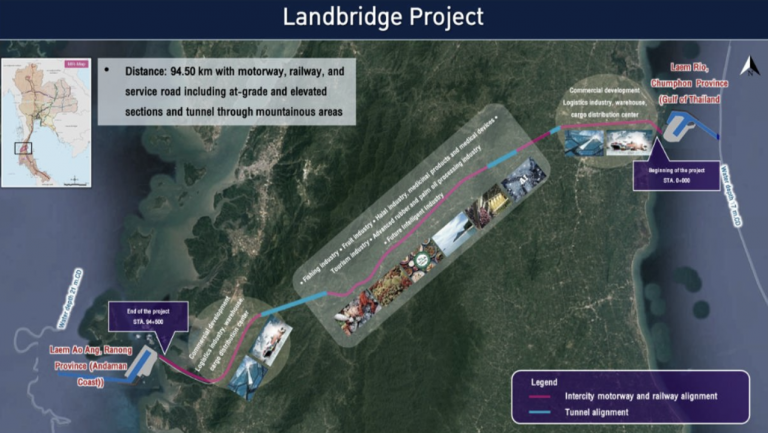
The “Land Bridge” Project, or the Southern Economic Corridor connecting the Gulf of Thailand and the Andaman Sea (Chumphon–Ranong)

is currently under feasibility studies by the Office of Transport and Traffic Policy and Planning (OTP), including preliminary design, environmental impact assessment, and investment model analysis.

If successfully implemented, the project will become one of Thailand’s largest mega projects, with an estimated investment value of THB 1 trillion. It will include the development of two deep-sea ports connected by rail (double-track railway) and motorway infrastructure under the “One Port, Two Sides” concept, along with the development of surrounding areas for supporting industries and commercial activities.

Key Port Locations: Laem Riow & Laem Ao Ang

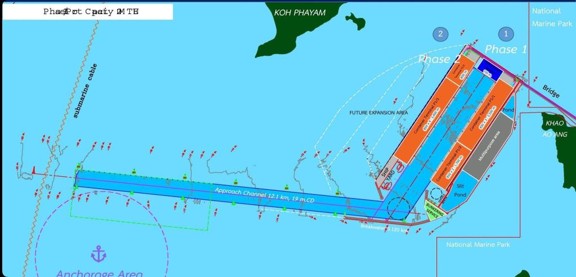
The Land Bridge Project has identified Laem Riow in Chumphon and Laem Ao Ang in Ranong as suitable locations for deep-sea ports, each with a capacity of 20 million TEUs.

The project includes a 93.9 km connectivity route comprising motorways and double-track rail systems, including standard-gauge rail (1.435 m) for freight transport and 1-meter gauge rail for passenger connectivity. The route includes elevated sections, at-grade roads, and three tunnels to support integrated transportation.

Over THB 1 Trillion Investment Plan: Integrated Ports, Railways, and Motorways

The preliminary study estimates the Land Bridge Project at a total investment value of approximately THB 1.001 trillion, covering deep-sea ports, cargo transfer facilities, and Chumphon–Ranong connectivity infrastructure.

Investment Breakdown:

  • Deep-sea ports: THB 636.5 billion
    • Chumphon Port: THB 305.7 billion (capacity: 20 million TEUs)
    • Ranong Port: THB 330.8 billion (capacity: 20 million TEUs)
  • Single Rail and Transfer Operations (SRTO): THB 141.1 billion
    • Supporting cargo transfer and logistics operations on both sides.
    • Ranong Port: THB 330.8 billion (capacity: 20 million TEUs
  • Transport Connectivity (Motorway & Double-track Railway): THB 223.6 billion
    • Connecting Chumphon and Ranong through integrated road and rail networks.

Development Plan: 4 Investment Phases
The project will be developed in four phases, gradually expanding port capacity, SRTO facilities, and transport infrastructure to support increasing cargo volumes.

  • Phase 1/1: Initial development of ports, SRTO, motorway, and railway infrastructure with a total investment of THB 522.8 billion.
  • Phase 1/2: Expansion of port capacity and motorway connectivity with an investment of THB 164.7 billion.
  • Phase 1/3: Further expansion to increase port capacity and logistics facilities with an investment of THB 228.5 billion.
  • Phase 1/4: Final expansion phase to achieve full capacity, including Chumphon Port expansion to 20 million TEUs, with an investment of THB 85.2 billion.

The project aims to establish a world-class logistics gateway, connecting the Gulf of Thailand and the Andaman Sea while strengthening Thailand’s role as a regional maritime and trade hub.

Motorway and Railway: A Land Bridge Connecting Two Seas

The Land Bridge’s connectivity infrastructure will feature a 6-lane motorway and double-track railway systems (1-meter gauge and 1.435-meter standard gauge) along the MR8 Chumphon–Ranong route, covering 89.35 km across Ranong and Chumphon provinces.

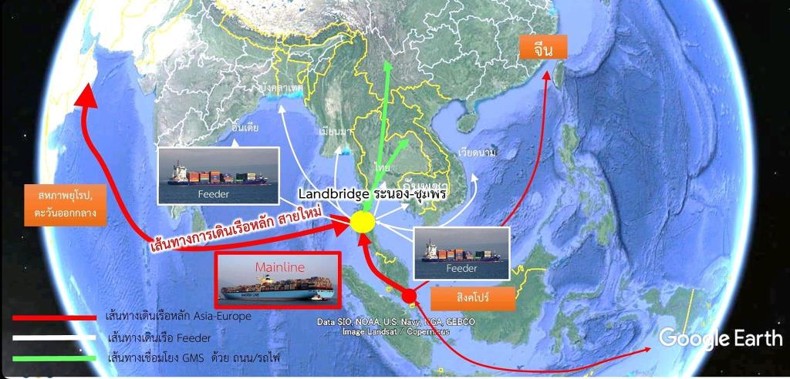
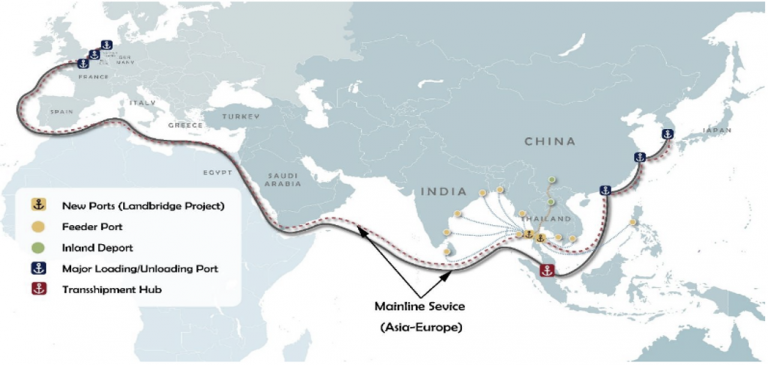
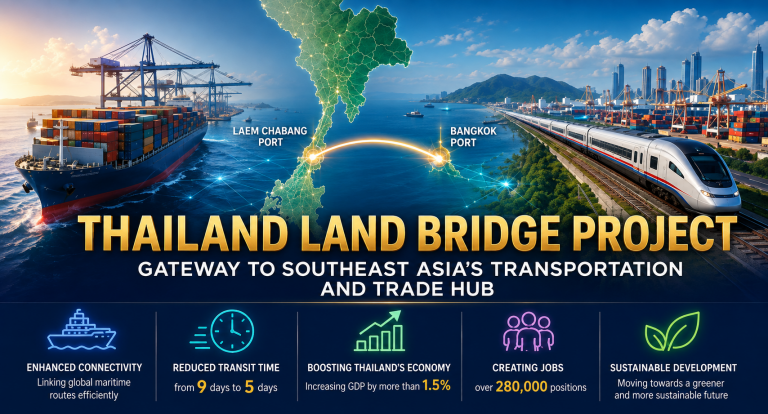
Leveraging Thailand’s strategic location as a regional hub, the project aims to create a new maritime trade route connecting the Indian Ocean and Pacific Ocean. It is expected to reduce shipping time via the Malacca Strait from 9 days to 5 days, lowering logistics costs and strengthening trade links with the EEC, GMS, Southern China, ASEAN, and BIMSTEC.

The project will support cargo flows between Europe, the Middle East, India, Bangladesh, Vietnam, and China, serving as an alternative transshipment hub for vessels of approximately 5,000–6,000 TEUs.

In addition to transportation infrastructure, the project will promote port-related industries, free economic zones, and investment opportunities around Chumphon and Ranong ports, enhancing Southern Thailand’s economic competitiveness.

Estimated Cargo Volume Through the Land Bridge:

Ranong: Approximately 19.4 million TEUs
Chumphon: Approximately 13.8 million TEUs

Cargo categories include:

1. Transshipment cargo

* Ranong: 13.6 million TEUs
* Chumphon: 12.2 million TEUs

2. Thailand’s import and export cargo

* Ranong: 4.6 million TEUs
* Chumphon: 1.4 million TEUs

3. Southern China and GMS cargo

* Ranong: 1.2 million TEUs
* Chumphon: 0.2 million TEUs
The Land Bridge is also expected to stimulate surrounding developments, including commercial areas, residential zones, light industries such as automotive parts, food processing, logistics, and service industries.

Enhancing Maritime Connectivity – Complementing, Not Competing with Singapore Port

The objective of the Land Bridge Project is to establish Thailand as a regional trade gateway, supporting import and export activities for Thailand and ASEAN countries. It will facilitate cargo flows between China, Laos, India, Europe, and ASEAN markets.

The project is not intended to compete with Singapore Port, which specializes in handling large international vessels. Instead, the Land Bridge will complement existing maritime networks by providing an alternative logistics route as traffic through the Malacca Strait continues to increase and faces capacity limitations.

By connecting Chumphon Port on the Gulf of Thailand and Ranong Port on the Andaman Sea with motorways and double-track rail systems, the Land Bridge aims to reduce transportation distance, shorten delivery times, and create a new regional shipping route.

SEC Act Development and Establishment of a Dedicated Agency

The development of the Land Bridge Project will further enhance the capabilities of Laem Chabang Port and the EEC area. The Office of Transport and Traffic Policy and Planning (OTP) is studying the preparation of the Southern Economic Corridor (SEC) Act, following the successful model of the Eastern Economic Corridor (EEC) Act, along with the establishment of the SEC Policy Office to drive and oversee the project.

As a large-scale project requiring significant investment and international participation, the Land Bridge requires a specific legal framework and dedicated authority to provide investment incentives and ensure effective project management.

The port, railway, and motorway developments are planned as an integrated investment package through a Public–Private Partnership (PPP) model, allowing private investors, including Thai and foreign companies, to finance, construct, operate, and market the facilities.

The project is expected to generate economic benefits through:

* Job creation
* Development of port-related industries
* Establishment of industrial zones
* Income distribution and economic growth

The concession period is expected to be approximately 50 years, targeting global shipping lines, experienced port operators, and strategic investors from countries such as Taiwan, China, Japan, France, and the United Kingdom.

Source: Office of Transport and Traffic Policy and Planning (OTP)
15 June 2026